
Decolonize Your Lust
Across Africa, in the world at large even, a pervasive linguistic preference for vulgarity in English exists in the performance of sex acts and, as always, colonialism and neocolonialism are to blame

The choice of language and the use to which language is put is central to a people’s definition of themselves in relation to their natural and social environment, indeed in relation to the entire universe.
—Ngũgĩ wa Thiong’o, Decolonising the Mind
The language you solve algebra in is the language you fuck in. The language you flirt in is, more or less, the language you also fuck in. Things are that simple, but to add some Guinness to the palm wine: Many urban folks in post-colonies cannot imagine carrying out dirty talk in their indigenous languages. It strikes them as absurd. Preposterous. Laughable, even. The mere notion of it, even when posed as a hypothetical, makes them either curdle and cringe or seethe with rage and disgust.
Why flirt or engage in erotic talk in Örö, Urdū, Yorùbá, Ejagham, Ìgbò, Twi, Ewe, or Arawak when English, French, Dutch, and Portuguese are readily available? Why, indeed, go through the entire hassle? A good number of people do not bother with the question. It doesn’t even make a debut or phantom appearance in their psyche. It is not a serious thing to consider. In the bedroom, they prefer to defer, without much thought, to vulgarities in these European languages which they grew up speaking. Daddy. Papi. Oui. All the way, as God intended.
Obviously, English1 or not, some people find dirty talk2 offensive or intrinsically comical and unnecessary. Roleplay carried to absurd, Freudian extremes. A kitsch, borderline-incestuous performance3 prone to ripping apart the already thin veil of sex as an activity that can turn awkward or ridiculous at any slight turn, an activity easily undone by a harmless gesture at the wrong moment; a poorly-intoned cuss word; a sexless memory superimposed, by chance, onto the entire performance; a rogue scent; a random episode of derealisation that can, in the right register, reduce the act of sex in the mind’s eye to a phalanx of phalluses and pussies and spit and sweat and shirtless bodies miming a simple pendulum going haywire.
The majority of these urban folks who fancy dirty talk, however, do so in English. Not necessarily because ‘fuck’ is easier to blurt out or that ‘dirty, little whore’ has a raunchy zing to it or because ‘you want to be a good girl for mummy?’ will induce doe eyes in a kneeling lesbian, but simply because it has now become their lingua franca. It is, for many, the only language they speak best. The language they wrote their O- and A-levels in. The language they use in coining nicknames for their bullies and laughing at a scammer who tries to make them part with the money they want to use and buy shawarma for the first time in six months. The language they use in asking Grok stupid questions on Twitter4. The language they use to lament about their governments and the elites that protect the comprador bourgeois class in these former colonies. Their beings are caught up in English. Hence, they can do nothing, as a consequence, but have sex in the language they have spoken all their life—against their will or not.
Expecting them to otherwise carry out sex in any other language is naïve or requires a deep misunderstanding of the historical and socio-political events that have led up to this two-faced reality5. But what about those urban folks who are curious and want to moan or carry out dirty talk in their indigenous languages, unencumbered like the natives more fluent than them in these languages? The bilinguals and polyglots who, in all their degrees and western education, have never, for whatever reason, considered the possibility before because of English’s paralysing ubiquity? The L2 speakers6 who are repelled by the suggestion of others in this regard, decrying the sentiment as performative? What drives the blind spot of the former two and informs the latter’s visceral disgust?7
How can these bilingual, sometimes trilingual, urban folks across the globe sing, pray, curse, bargain, but not love or make love in something as intimate and ancestral as their mother tongues? But how, how did I, and we, get here? It’s simple, really: the culprits, as you can already imagine, are the guilty duo of colonialism and neocolonialism. The real question, however, and the focus of this essay, is: in what particular flavour and in what specific ways do these evil twins of the west carry out this now silent erasure, and of what relevance, if any, is this seemingly frivolous inquiry, even, in these fascist and war-torn times, these existential overtures of regional and global ecocide?
ORIGIN OF THE DISCOURSE
In 2019, a week before my matric, I was seated at the female hostel in UNICAL with a love interest. Out of the blue, and as a joke, I asked if she’d ever imagined moaning in our local dialect, Oro. Surprise, confusion, curiosity, then laughter. She was the more fluent speaker, so she made an attempt at a couple of phrases, literal translations of common English porn exclamations, and we laughed off her attempt.
I’d introduced the notion as a joke, and she’d found much hilarity in it. In retrospect, my framing and her reaction was odd—the fact that this suggestion often sparks either laughter, curiosity, dismissal, and disgust, but mostly disgust, and laughter in most people is what I mean—but I didn’t think this much about things then. The observation was just a way to prop myself as interesting enough to sustain her often fleeting attention. I didn’t factor in colonialism or neocolonialism. I wasn’t seeking virality. I didn’t mean to snorkel through a waterfall of historical complicity. I wasn’t thinking deep about any of it. There was honestly no reason to. I was trying to be funny. And I was happy to have succeeded. Fin.
Last year, around this time, I made a throwaway post on Twitter about the linguistics of sex. I posited that colonialism and neocolonialism—a huge leap from 2019—had a hand in why we find it difficult to moan in indigenous languages. The quote tweet, to my surprise, went viral and sparked discourse, bringing in a flurry of takes and counter-takes from all over the world, people agreeing, others fallacy-testing the premise’s logic for obvious loopholes, the rest asking for contextualising caveats to deepen my insight for them by rendering a house of cards from the deck I’d pulled out of thin air.
For days my phone buzzed with notification after notification from people in Denmark, Germany, China, India, Malawi, Ghana, Cuba, Spain, all corroborating or contending the premise. They remarked about not being unable to carry out or endure listening to dirty talk in their indigenous languages or even reading smut in it. Their languages were too sacred for them to distort like English enables, but this, I argue later, is as a result of latent classism and doing a word-for-word translation of English vulgarisms into their own languages.
When it comes to moaning or dirty talking in one’s indigenous language, literalism in translation from English is not decolonial.8 It neglects existing cultural nuances, stifles the erotic as conceptualised by natives, and neuters and tanks any libidinal activity by introducing glaringly awkward semantic constructions that exaggerate the final outcome, which, in turn, cartoons the entire prospect. But these polyglot urban folks from around the world who’d never met almost all had the same things to say about dirty talk in their indigenous: a feeling of shame, awkwardness, and a lingering feeling of disrespect.
A week later, the discourse culminated in a space hosted and co-hosted by professor of linguistics Dr. Uju Anya and I. Days earlier, before the space, she’d quote tweeted “decolonize your lust…” (what has become the title of this essay) in response to another quote tweet made by a user insinuating violence if their partner were to ever moan in Yorùbá during sex. It was that disgust, which Prof. Uju countered, that made me accept Ololade’s request, days later, to write an essay on the subject for The Republic when she reached out, an essay I started and abandoned due to personal misgivings.
Before the essay request, though, came the space where Prof. Uju and I and all the people who took up the stage at one point talked about the evil twins of the West, the verbal and social rituals indigenous people garnered around sex (kicking against the notion that muteness in bed was the historical norm), porn, the linguistics of sex, and how this problem, this distortion creeps into romantic performance in post-colonial states. We covered a lot on that space, but I never got around to mapping out my thoughts on the subject in a comprehensive way, and this essay seeks to correct that. I have come to defend my position. To contextualize my dissent, ground it in its bitter and battered long history that implicated my ancestors, and affects my generation in its own way.
THE EVIL TWINS OF THE WEST
Colonialism and neocolonialism9 have yanked away indigenous languages from the bedroom of the urban youth. Long before we spoke the language, violence formed the structures for passing down the coloniser’s language to the colonised, and now to the children’s children of those broken children. Parents, following that same stifling script, inflict English on their kids without doing the same with their indigenous language.
The child in Finland learns Finnish, English, and Danish simultaneously, and at about the same age, but, as for the child in Ghana, most parents—not wanting their kids to tamper with their received pronunciation from school—will opt to teach them English alone, saying they can learn Twi, Akan, and Ewe much later, when they grow up, in the future.
Some do; many never.
COLONIALISM: THE PROMORDIAL TWIN
English came from Europe through the Bible and the canon and the whip. It was artificially implanted into Africa via incredible geopolitical violence. The missionaries acted as midwife to the mischief, while the colonial governments enforced it through corporal punishments in schools. None of this is new. None of this is news. But it’s necessary to emphasize this here, because, almost three or four generations removed from the initial phase, we do not locate the violence as rippling, even though it still ricochets in other salient ways.
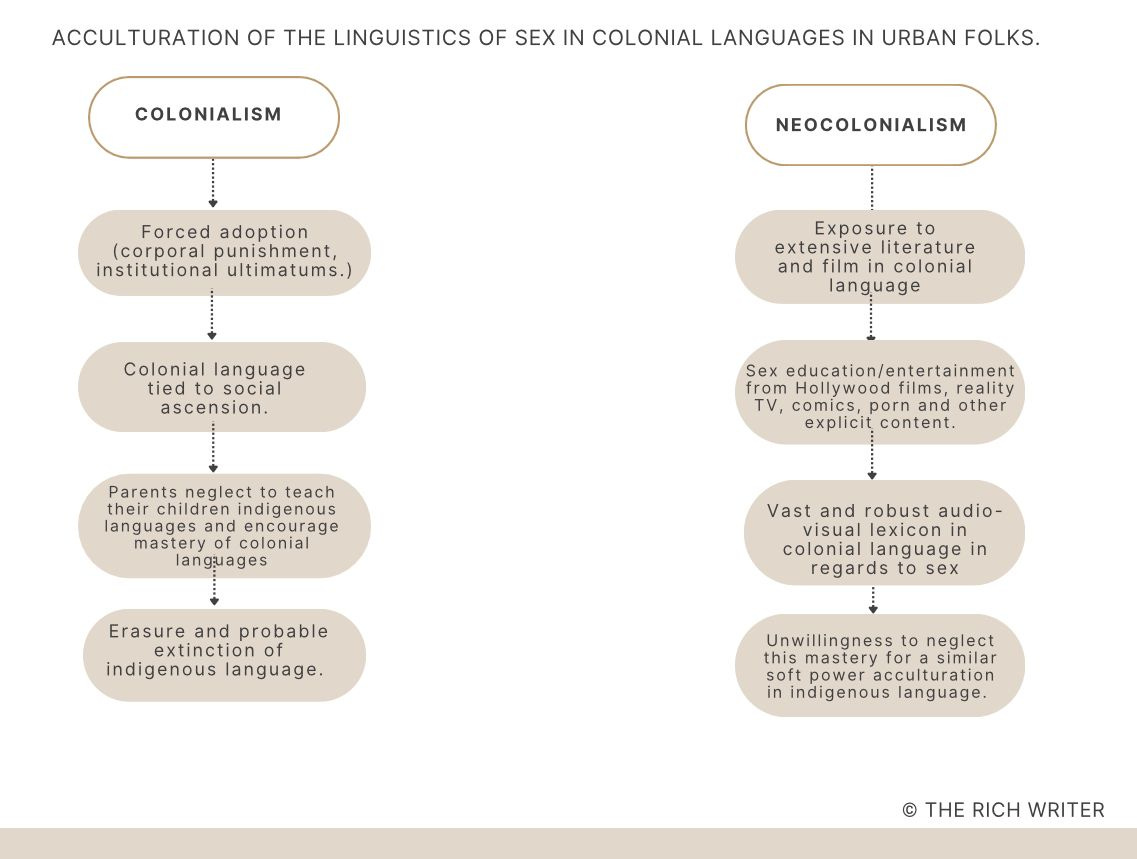
The colonialists tied their language to ascension within the colony. A Nigerian from Ìgbò, Efik, or Hausa, required a mastery of English to gain status and occupy relevant offices within the quasi-state. The epitome of being a Nigerian meant speaking and expressing one’s self with a received pronunciation that matched their oppressors. Parents who could afford to send their children to the grammar schools in town reinforced this. The teachers in this school whipped those who defaulted to their native tongue or whatever creole the peasant class in these colonies had conjured up from these colonial languages. English or nothing. English or the whip. English or repeating a class. All of this was violent.
If, as a child, you learn that speaking your language can bring you such pain, then, it would be wise to avoid it, and to implicate any of your peers who tried to speak it in your presence. English turned children into cops and self-mutilating merchants of their mother tongue. While the school rewarded excellence in English with acceleration through the system—scholarships to prestigious colleges, extra care and lessons from instructors, rapid incorporation into the colonial machine, being turned into a beacon of envy and civilisation to drive your fellow indigenes towards accelerated acquiescence—while English grew in prestige, becoming even more entangled in the material, social, political, and sexual life of the Nigerian, their indigenous tribe and practices (most especially language) suffered and atrophied along colossal lines of neglect.
The colonizers left, but their logic remained. And distorted things further. From primary school all through uni, students in post-colonies are required to pass English or repeat a class. Whether you pass or fail that foreign language determines the kind of future you’ll have. English is existential. Parents and guardians are keenly aware of this, too, so many of them, no longer under the guidance of the colonizers, reinforce “the fatalistic logic of the unassailable position of English”10 in their children’s lives through corporal punishments when the kids make grammatical errors, discouraging them from speaking Pidgin and Nigerian English and any other adjacent creoles, neglecting to teach them their indigenous languages so as not to taint how their children will come to speak English. All these practices culminate in colonial alienation11, and create an asymmetry of fluency in a class of citizens who are ready for the next phase of neocolonial messaging and massaging through Western pop-culture.
A child who was schooled out of learning his mother tongue is not going to miraculously just wake up one day as an adult who moans in it, especially not when they’ve been taught to associate it with so much negativity. Also, not when they can live the best life in the post-colony and even gain access to the diaspora from showing an übermastery of English alone, alongside other requirements, of course.
NEOCOLONIALISM: THE TWIN IN THE INVISIBLE CLOAK
The infamous scene in Rob Reiner and Nora Ephron’s When Harry Met Sally where Sally moans in front of Harry to a full restaurant mirrors the scene in Reginald Hudlin’s Boomerang where Strange (played by the immaculate Grace Jones) quips “pussy, pussy, pussy”, to Marcus Graham, played by Eddie Murphy, also in a full restaurant. These movies—one White, the other Black—were big hits when they came out, are both classics, and featured female characters moaning loudly in packed diners, a fantasia set-up that carries erotic familiarisation.
Any young person from any post-colony who speaks and comprehends English is privy, provided they engage shamelessly in piracy, to a vast library of media with no shortage of sex, from the soft to the hard core to the taboo. The grammar and linguistics of sex is everywhere you turn for entertainment. You are inundated with the risqué at all turns.
Reality TV (Temptation Island, Love Island, Love is Blind, The Ultimatum, Heartbeat), Prestige TV (Succession, Mad Men, Industry), queer media (Heated Rivalry, First Kill, Interview With the Vampire), Hollywood/indie films (50 Shades of Grey, Mulholland Drive, Anora), video games (e.g. Bayonetta), animation (Family Guy, Futurama, South Park, Seth Rogen’s Sausage Party), even sprinkled as innuendoes and suggestive scenes in children’s media (e.g. Happy Feet). Over a hundred porn sites, both popular and fringe, and on social media apps like Twitter and Telegram: sex, sex, sex. In all flavours, all kinks, no matter how niche, even in music videos, especially those American ones from the early 2000s, and all in English.
Directly or indirectly, almost three generations have gotten their sex education from Western media such as the ones highlighted above. Given that colonialism also deposited religious fanaticism in us, many of us grew up under parents whose idea of sex education was wrapped up in extreme purity culture: fear mongering through deliberate misinformation and threats of violence and disownment at the onset of a pregnancy or at the prospect of having a partner while still under their roof.
So, we turned, unwittingly, to the screen; we turned to the internet, vast and endless, and it folded our tongue like pizza dough. We were armed with all the slang and lingo we’d need for the shoddy sex we’d have in the school’s bathroom at fourteen with our classmates, armed with vulgar words to express the warm feeling in our thighs at nineteen, our first night in a hotel with a hot man or woman or they/them. The movies taught us sex. Fast sex. Sex as strife. The porn stars, even in all their exaggerated affectations, taught us how to moan. We had celluloid surrogate parents. And this is the very genius of neocolonialism: it indoctrinates under the guise of educating.
While corporal punishment was required for the former, seduction and propaganda is employed for the latter. Most of these movies are masterpieces. Timeless pieces of human ingenuity. Time-stamped art. All that is indisputable, but being fluent enough in English and enjoying these films, there becomes almost no need to clamour for films, including erotic films, in one’s indigenous language. English solves all that problem already. It is a buffet like no other. You have been tossed into the best the world has to offer on screen. All you can be is grateful and lap it up until what is foreign becomes eerily familiar.
The beautiful and dangerous thing about propaganda is that uncovering the lie doesn’t make you deconstruct towards truth. When overexposure contaminates a film strip, almost no amount of time spent in the dark room can reverse that. Knowing diamond engagement rings were designed and marketed chiefly by De Beers doesn’t automatically make you decry them and the symbol diamond engagement rings represent in contemporary weddings. Knowing how colonialism and neocolonialism create a glaring asymmetry of fluency in you between the colonial language and your indigenous one doesn’t necessarily make you want to learn yours. If anything, it makes you seek for your favourite clip, and rub one out while cumming in honour of the Queen and the Berlin Conference.
ON VULGARITY IN THE POST-COLONY
Halfway into Bong Joon Ho’s 2019 Parasite, the rich patriarch Mr. Park sniffs out a rouge smell, one he associates with the subway, and Mrs. Park comments that she can’t remember when she last rode it, too. The nostalgia shores up desire in Mr. Park who asks her if she’s wearing the cheap (emphasis on cheap) panties they’d both seized from their driver who they thought fucked his girlfriend in the car and left them there. His driver was set up, but that’s not the point; the point is: Mr Park says he’ll get even more turned on if his wife is wearing those exact cheap panties worn by their fired driver’s girlfriend.
In David Lynch’s Blue Velvet, a grown man on all fours yells “mummy” severally like a tantrum-throwing toddler, spit drooling from his mouth, then he hits her and rapes her; in a later scene the woman, a singer, has sex with a guy who’d been hiding in her closet, and she asks him to hit her because it gets her going. Billions, the American TV series, opens with the attorney general of the state getting a cigarette put out on his chest, followed by a trickle of piss by his wife in a dominatrix leather leotard.
Even when shame is absent, we invent ways to make sex to feel like a sin.
Vulgarity is an art12. Even more so in the context of sex, where desire, no matter how minimally transgressive, often makes private, taboo demands that would otherwise cause us to shrivel in public with shame. And all arts are also crafts. Open to tinkering and startling deviations: susceptible, in short, to an avant-garde treatment.
Vulgarity often lays bare our psychosexual ironies. Revulsions drive erections and taboos lubricate labias. Our sexual appetites, even for the vanilla, border on some form of socio-political transgression. Even when shame is absent, we invent ways to make sex to feel like a sin. We fuck in parks. In balconies. At homecomings in our former rooms. Friends fuck their friend’s spouse. People roleplay as characters that are opposite to their public persona or in contradiction with their personal values and politics. The vulgar, the taboo, can and does amplify the erotic.
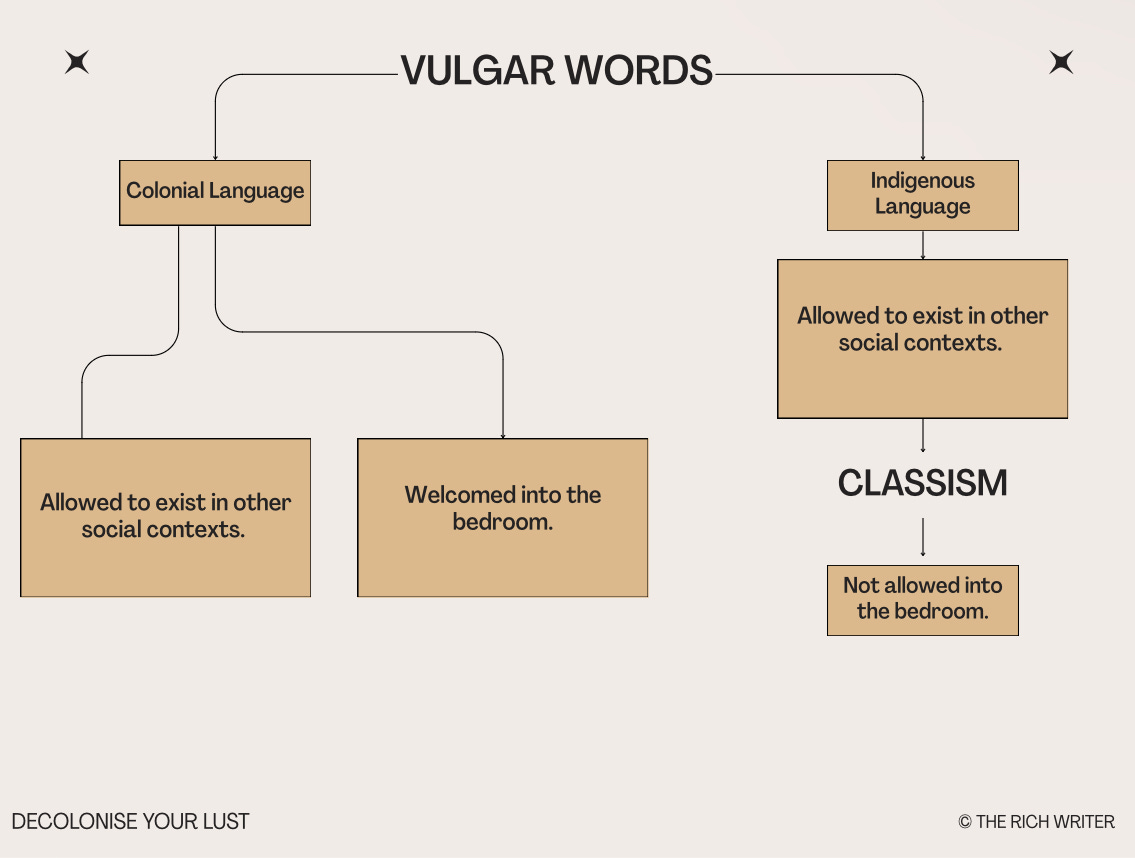
This explains, to a degree, why we drag expletives to the bedroom with us. Fuck is a curse on the subway, but a blessing in bed. Slut is a slur, but it can help you slur your words while an orgasm tears through you in your childhood beedroom. Bitch should come out of the mouth of no man except the one fucking you against the kitchen counter in a shortlet in Turkey. These contradictions are not at all contradictory. But something weird happens to vulgar words in post-colonies, a distortion manifests in the relation of the urban polyglot with the vulgarities of their indigenous languages: they can tolerate it in the streets, but they cannot reconcile it to the bedroom. It is an asinine demand for them.
Dick can be an insult or the name of a writer from New York or slang for a penis in some dark romance written by some white woman in downtown Minnesota. But gbola, kpekus, toto—the names of reproductive organs in some indigenous languages and creoles—cannot be reclaimed by the urban youth in bed. Beyond vulgar, they are crass, or as Nigerians would say: razz.
It is understandable why most young, urban women do not bother to reclaim these words—they have suffered misogyny, catcalls, and sexual harassment from men hurling these words at them. While a number of women are consistent with their insistence on no derogatory words—whether in English or otherwise—some are more willing to acquiesce when it comes to English vulgar words, reclaiming those words for themselves in the bedroom, than they are with vulgar words from their indigenous languages.
The men, too, are put off or turned off by such usage. They level the same complaint: crass, razz, uncouth. But they have no qualms saying, dick, cock, pussy, cunt, cracked, nut, etc. Their utter disgust for these same words, or simply dirty talking, in their indigenous languages is two-fold, a) an asymmetry of fluency: they aren’t fluent enough in these languages, in their grammar and lexicon and haven’t learnt to separate the vulgarity when the erotic calls for it, hence they don’t allow these vulgar words have a double life, and b) classism: most of the people who are incredibly fluent in indigenous languages aren’t educated in the western sense and live in conditions that are not aspirational within the post-colony’s new context, and this creates a situation where urban L2 speakers superimpose their subliminal hatred for these people’s social position with the language by a simple act of association. It’s insidious and doubly fatal.
The historical force of colonialism and the contemporary force of neocolonialism conspire to create a unique material and linguistic hierarchy in the post-colony metropolises. Former colonies were arbitrary amalgamations: tribes were cobbled into the same geopolitical expression without much care for former regional divides. All are forced to operate under the same legal authorities, conduct trade with the same currency, and communicate in a shared language.
This forced conglomeration forces inter-ethnic communication that’s mediated by either the official lingua franca or the informal post-colony’s own creole. City folks are more likely to be largely fluent in the official lingua franca, and a handful might know how to speak the creole, or, at least, understand it, then a select few are fluent in their indigenous language which is too regional to be understood by the entire polity.
Village folks and the peasant class excluded by their economic position from getting a western education are often fluent in their post-colony’s creole—their non-western educated ancestors who interacted (I’m using the term here broadly) with the colonizers created the creoles—and their indigenous languages, with a handful of them being able to speak and write fluently in English.
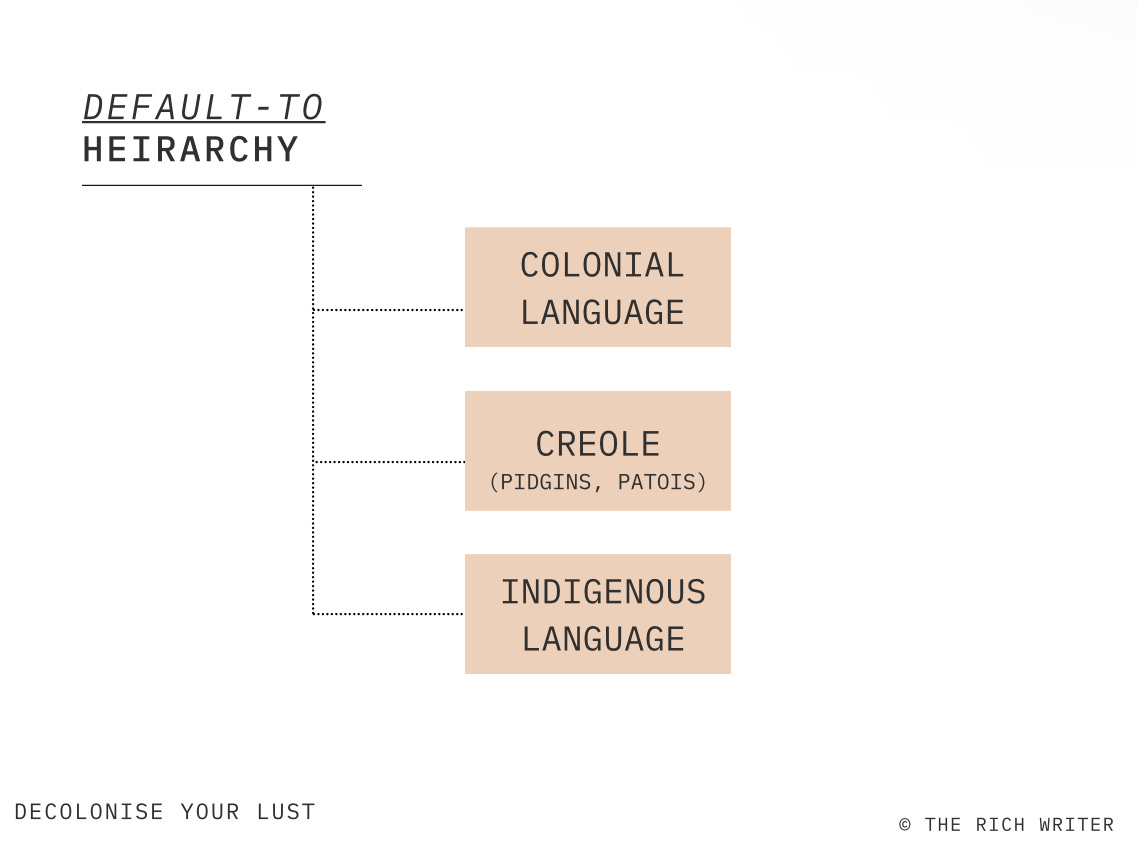
This lingui-economic divide creates class antagonisms and attitudes that fester and manifest in subtle ways. For example, every interaction in the post-colony requires an invisible rock, paper, scissors between both speakers to decide what language to default to, and the overall hierarchy goes like this:
Colonial language
Creole
Indigenous
What language is used in the bedroom is then determined by four criteria:
Mutual Tribe: cities are multicultural melting pots. It is normal, especially if you’re from a small tribe like mine, to go through your entire dating life without encountering many people from your tribe, so, for the most part, the prospect of having to moan or dirty talk in your indigenous language will be nil.

Mutual Fluency: after meeting someone from your tribe, there has to be a mutual level of fluency. An asymmetry here will result in a default to either the colonial language or the creole.
Mutual Preferability: mutual fluency could be ruined if you both have different preferences between both indigenous and colonial languages. They might understand you and know how to speak like your indigenous, doesn’t mean they will, and they might be fans of the colonial masters.
Mutual compatibility: being on the same page on dirty talk and dirty talk in your indigenous language must also be factored in.
RELEVANCE, IF ANY
It’s not that urban youths in post-colonies aren’t conducting dirty talks in their indigenous languages, which is true, but that indigenous languages are slowly being eroded13 by the evil twins of the West. These languages are facing extinction in the near century. The fate of many indigenous Caribbean languages awaits them.
If our generation fails to learn our indigenous languages and create literature and edutainment in them to expand further enrich their already rich vocabularies, then we would have had a hand in severing our mother tongue, and then, like now, it won’t matter if urban folks are moaning and dirty talking in indigenous languages, because the peasant class and poor people will carry on the torch, as they’ve always done.
For what is revolutionary and decolonial to the urban youth is quotidian and commonplace to the villagers. If we can skip the shame and admit we’d love to learn from them what goes on in the bedroom in our indigenous languages, we will have to drop our classism at the door and not allow our arrogance make us translate western stock phrases from porn and media literally into our own languages, desecrating them.
Throughout the essay, I use English to denote most colonial European languages, including French, Dutch, and Portuguese.
Dirty talk encompasses things said before (what we call flirting) and during sexual acts (what we generally think of dirty talk as) to enhance the overall experience for both partners. The blog in the embedded link does a good entry-level break down on the science behind dirty talk.
Bauman, Richard. (2009). Verbal Art as Performance1. American Anthropologist. 77. 290 - 311. 10.1525/aa.1975.77.2.02a00030.
To hell with “X”.
Following the discourse on Twitter, a number of people insinuated that a Nigerian moaning in English was performative, and that is false claim to make. Anyone who wants to invoke the Ngũgĩ wa Thiong’o’s argument here — that Africans must express themselves in African languages — against the use and assimilation of European languages must take things to the same extremes the Kenyan author did and make that claim in their indigenous language or it’ll fall flat and ring hollow.
Whereas most L2 speakers take on English or any European language as their second language, the young people in question here speak English as their primary language and their indigenous language as their second. Hence, the grammar, inflections, and intonations of the European language ends up affecting how they speak their indigenous languages.
It is curious that while you can find a number of people threatening violence at the prospect of their intimate partner moaning or dirty talking in their indigenous language, you’ll be hard-pressed to find the opposite: someone more fluent in an indigenous language threatening violence on their partner if they were to moan in English. A distinction that shows colonialism’s hand at play.
Literalism is classist in this regard, and I explain how later.
The evil twins of the West.
An infamous phrase from Chinua Achebe’s seminal essay: “The African Writer and English Language”.
For more on this, read Decolonizing the Mind.
And a science: https://www.medicaldaily.com/science-dirty-talk-and-why-it-increases-sexual-pleasure-349854
Mba, Okechukwu & Oguadinma, Anthony. (2025). Endangerment of Indigenous Language and Cultural Identity: The Decline of Igbo Language among Secondary School Students in Umuahia, Nigeria. International Journal of Language and Literature. 13. 61-76. 10.15640/jll.v13p8.
Gordon, Augustine Emamuzo & Ogbu, Angela Ijeoma. (2025). Endangered Identity: Causes and Consequences of Dialects’ Extinction in Nigeria. International Journal of Research and Innovation in Social Science (IJRISS) https://dx.doi.org/10.47772/IJRISS.2025.903SEDU0113
This was such a thorough and enlightening take on the topic!!! I’ll be back to do another re-read, but well doneeeee, Mae 👏🏾
I haven’t read to the end right now but the essay is already so thorough