
That This Thing There
Nigerian English: the neglected middle child between English and Pidgin

In contemporary Nigeria, there’s an invisible hierarchy between English and pidgin. English dominates formal spaces and is the standard format in which literature is documented, while pidgin rules the streets and has been adopted by the music industry—Afrobeats, for example, has, from its inception, infused pidgin, with much success, into its lyrical lexicon, almost adopting the language completely for itself.
While these are generalizations with sieve holes, they hold a semblance of truth. However, there is a victim of both English and pidgin. This invisible missing third tier which most people, who resort to prescriptive linguistic tirades in an effort to uphold traditional grammar, ignore is Nigerian English.
A Crude Definition
Nigerian English is a form of creole that resembles English more than it does the pidgin we’re familiar with. Its grammar doesn’t follow any hard laid down rules, which is not to say it is completely amorphous. Its nouns, for the most part, are full of misnomers—tea, for example, refers to hot chocolate, not necessarily chai or mocha; it prefers generic trademarks: Indomie is used an umbrella term for noodles, and Omo colloquially refers to all types of detergents. Nigerian English is truly littered with generic trademarks as a taxonomic tool for categorizing similar products, hence, Lipton stands in place for all kinds of herbal teas while Milo is used to specify hot chocolate.
Adjectives suffer the same fate and are almost always used in the superlative sense: “tallest”—for the tallest person in a group or given vicinity; “yellow”—for fair people; “professor or prof”—for someone who’s book smart or likes to read a lot.
By now you’re beginning to get the scope of Nigerian English. It’s all around us. Words like “severally”, which has been inducted into the dictionary, and “trafficate”, which autocorrect still flags, fall under Nigerian English.
Sometimes the language can be seemingly nonsensical, turning a word like “consign” into a Janus word that means “concern”, a fate meted out by the fact that, when mispronounced in that Nigerianesque way of ours, both consign and concern sound like true homonyms.
An anomaly occurs when you go a step further: the words in the unorthodox lexicon of Nigerian English rarely combine to form phrases. Instead, in most cases, common English words are jumbled up in a syntax borrowed from an indigenous language or with no particular referencial origin except to signal the Nigerian spirit and flair1.
Just as a pair of shoes worn over time accommodates itself to the feet, language gets customized by its users: this is how nearly all accents and slangs and creoles are born. What we often fail to recognize is this alteration, or semantic mutation if you will, happens at different levels.
Poets break so many rules of traditional grammar to express themselves according to the dictates and demands imposed by a particular poem. In the same way, Nigerians have taken poetic license into everyday language to express themselves when frustrated or exhilarated in a way that English language, as banal and cagey as it often can be, doesn’t quite allow. Interjections are a small symptom of this tendency: I would no sooner expect a Nicaraguan to appreciate and use “enhe” than demand a Korean to desist from using the multiple variations of “aigoo”. Nevertheless, when Nigerians carry this tendency to sculpt language into phrases and sentences that deviate significantly from the standard English grammar, we mock, object and villify them for it.
Be Rest Assured: A Battered Gem
A good example of when we exhibit this mockery is seen in the disdain we display towards the immaculate phrase, “be rest assured”. Yes, it’s grammatically incorrect to use both verbs to modify the same adverb in this case, but we understand the intended meaning—what we have beef with is the form, because although it rolls off the tongue easier (in a Nigerian accent), it is formally, grammatically and otherwise incorrect. We willfully miss the tree for the forest.
Shakespeare broke, bent and reinvented grammar. Some might argue that he lived in a time where most grammar rules weren’t fixed, but one can’t say he wrote in a style that, save from being archaic, is nothing but highbrow creole. If one poet could do so much positive damage to a language, how much more an entire allegedly 200+ million people from a country where said language is the lingua franca?
The phrase “rest assured” is often used in formal documents or formal discourse, rightfully so, in such clime. But be rest assured two friends can toss that sweet phrase back and forth with abandon. We don’t need Oxford’s approval to legitimize it before we adopt it as ours.
If everyone from time followed traditional grammar up to this point we wouldn’t have half the words or expressions we use today. If Merrimam Webster were to wake up tomorrow and christen the phrase, Nigerians would lap it up, and it’ll suddenly become chic to use. Be rest assured I would rue that day and strike that jubilee with a dozen bayonets, because why should their shame be our shame and their pride our pride?
That This Thing There
The other day as I was about to cut okro2, I asked my mother to pass me the cutting stick; only, I didn’t say: “Mummy, could you pass me the cutting stick on the kitchen counter behind you?” Which would’ve been god forbid of me. Rather, pointing at the item, I said, “Mummy, pass me that this thing there.”
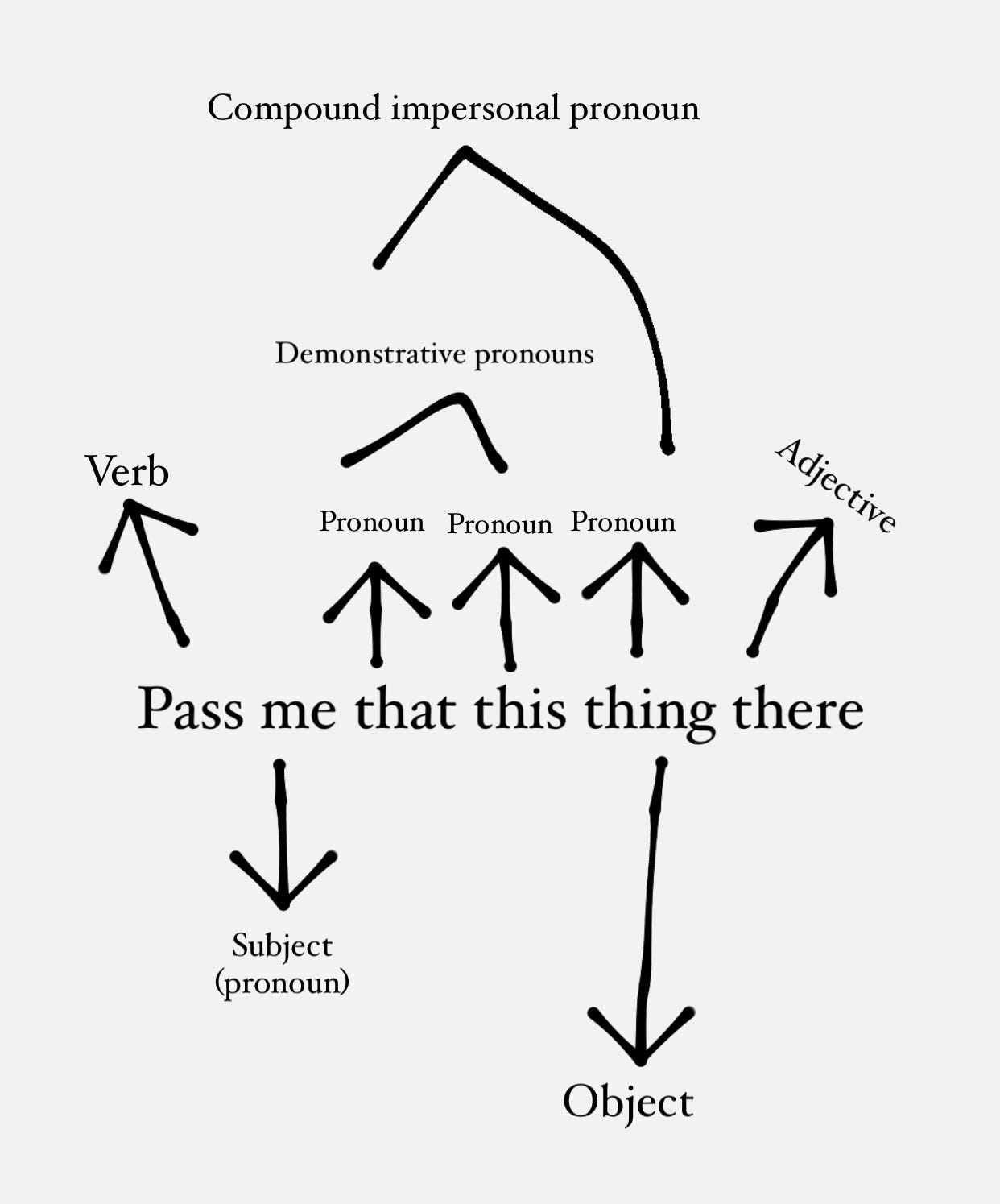
I paused as an epiphany seized me. That was by no means a correct sentence. In fact, I’d shot English a dozen times in the gut with that one utterance. The grammar was off; the syntax, wrong, no matter how terse and efficient the phrase.
Let’s parse the sentence.
Pass is the verb; me is both a pronoun and subject of the sentence. Pass me as a phrase simply means give me, as is common in the phrase, “pass me the salt.”
That & this are demonstrative pronouns; thing is a noun (remember your definition of a noun?); although there can either be a noun, pronoun, adverb or interjection, it appears in this case study as an adjective.
“…that this thing…” makes what constitutes in my opinion a compound impersonal pronoun and it’s also a noun phrase.
“…that this thing there” is an uncanny adjectival phrase.
In that one sentence alone, I compressed English into an elegant but utmost grammatically incorrect form just to achieve a simple goal. However, paired with my pointing finger, which added a layer of context, my mother deciphered my request and passed me the cutting stick without flinching in horror. She didn’t pause to give me a stern and stale lecture on my ungrammatical sentence, which I reckon sounded natural to her. Which brings us to this oft forgotten truth: language is a tool for communication, and communication is complete when understanding is established—grammar, which purists uphold like the ark of covenant, is just a set of rules imposed to reduce misunderstanding and ensure efficient communication. However, rules can be dropped or renegotiated by both parties involved.
Chess960, pioneered by Bobby Fischer, uses the same chess pieces arranged differently on the standard board: some rules are upheld, others are reworked. Most grandmasters mocked this variation but today, Fischer Random Chess3 has its own official separate tournament which other prominent grandmasters participate in. It makes sense that Bobby introduced that version, as a prodigy and genius of the game, few could blame his decision on being an amateur.
In Novels & On Screen
This brings me to the dilemma of unnigerian dialogues in books and films. At the risk of sounding like an uneducated simpleton who hasn’t consumed enough works from both media to hold such an opinion, I believe the dialogues to be canine dirty and incisor clean.
The English is either impeccable to the point of being sickeningly posh or conceived in pidgin bloated to the point where the language’s intrinsic musicality gets flattened into vegetable gibberish. Upper-class people speak as if they have tiny editors in their heads that tailor their sentences before they unzip their lips, while the lower-class can’t string a sentence free of exaggerated errors or questionable, forced pidgin; the middle-class characters alternates between both extremes like an RnB Afrobeats singer. All three classes of characters, which you could argue are contraceptive extremes in my outlandish depiction, tactically avoid the Nigerian English. They walk on eggshells with their tongue. That beautiful invention never gets center stage, to pirouette in high flown literature or films.
Partially because we are afraid to come off as uneducated, to the West, we avoid this crucial slant of ours, and, to avoid being accused of misrepresenting our society, we cobble together a character or two that speak pidgin bereft of its characteristic poetic brilliance. There’s an argument to be made for books and films where Nigerian English is incorporated without being put down that I haven’t read or seen, but I’d say we could be more inclusive of the language as we’ve pottered it with our tongue. Nigerian English is poetic, high in hilarity, and gives more room for natural subtext & clever subversions to express character and theme without betraying how most Nigerians articulate themselves.
Sure, there’s an understandable fear that these new phrases might phase out the old ones such that the coming generation won’t be able to detect the “correct” thing. But be rest assured that they, too, will have their own purists who will raise pitchforks in defense of stodgy, old grammar.
Honorable mentions include:
i. Turning garri stick
ii. How did that one now take and concern me?
iii. It’s like you don’t want to have sense in this life.
1. “…as I was about to chop okra” is correct but clunky and unnigerian, so spare me your pedantry.
2. Okro is the soup; okra, the vegetable—I know, but a recurring pattern in Nigerian English is the wanton creation of Janus words. Get over yourself.
Another name for Chess960.
This was so delicious to read man😭🤤I'm proud of you so much😭
This piece is beautifully written and comprehensively dissects the meaning of Nigerian English which, prior to reading this, I'd not fully acknowledged. Bravo!